
Easy Sourdough Bread Recipe
I’ve perfected this sourdough bread recipe over countless batches, and each time, it's a delightful journey through the world of artisan baking. Whether you're a novice baker or a seasoned enthusiast, the magic of turning simple ingredients into a beautifully crusty and aromatic loaf never fades.
Servings: 6
Ingredients
- 1/2 cup sourdough starter active
- 540 grams all purpose flour unbleached
- 1 2/3 cup water 95-100 F
- 2 teaspoons salt
Instructions
- In a large mixing bowl, add the sourdough starter and the water. Mix until you have a milky- mixture. It looks like the starter has dissolved into the water.
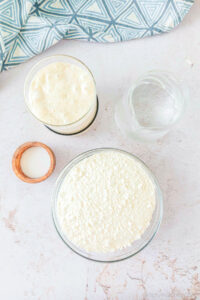
- Mix half the flour well using a Danish dough hook or a mixing spoon. Add the salt and the remaining of the flour. Mix well. You can use the whisk or spoon, but at a point, it will be easier to mix with your hand. The dough will be sticky and not held in a ball. Cover with a towel for 30 minutes.

- Stretch the dough: After the first 30 minutes, stretch and structure the bread. With one hand, pull on the dough at 12 o’clock and fold it back on itself. Rotate the bowl 90 degrees and repeat. Do this 8 times. Then cover the dough with a towel for 30 minutes for a second rise.

- Place the dough on a floured working surface (2-3 tablespoons flour). Stretch the dough, 16 times, like you did in the previous step. Place the dough back in the bowl and cover with a towel for 4-6 hours. Until the dough had doubled.
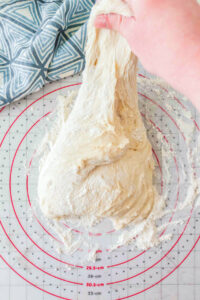
- Place the dough on a working surface and use the stretch technique in previous steps about 4 times. Then let the dough rest on the counter for 20-30 minutes.

- Place a Dutch oven in an oven, and heat the oven to 425 degrees F. Place the dough on a sheet pf parchment paper and score the dough. Once the oven is at temperature, transfer the dough using parchment paper in the Dutch Oven. Bake covered for 20 minutes. Take the cover off and bake for an additional 15-17 minutes. The internal temperature needs to be a minimum of 190 degrees F.

Notes
For years I followed the sourdough starter you can find on King Arthur. It worked, however, it was not as strong and structured as my new one. I finally caved in and bought a dried sourdough starter, followed their direction on how to activate the starter and within one week I had a solid starter. I say solid is if I forget to feed the starter at the exact time it is more forgiving. This starter has a nice structure and is very active. I haven’t tried to refrigerate it yet, but when I do I will follow their directives.
Feeding the sourdough starter: 1 cup of unbleached all-purpose flour and ⅔ cup water (I use bottled water as the water from the faucet has too many additives which impacts a sourdough starter)
Make sure the oven is at 425 degrees F and stable. This means once the oven “beep” tells you it is at temperature, wait an extra 10-15 minutes. If your temperature is too low, like 400 degrees F, the bread may not cook directly, may take longer to cook, and may have some bigger holes in the structure.
Scoring the bread: This is an important step. This will allow the steam from the bread to escape and not create unwanted cracks on the side. Use a sharp knife or blade. I use a straight razor blade.
Nutrition
Calories: 347kcal | Carbohydrates: 73g | Protein: 10g | Fat: 1g | Saturated Fat: 0.1g | Polyunsaturated Fat: 0.4g | Monounsaturated Fat: 0.1g | Sodium: 781mg | Potassium: 96mg | Fiber: 3g | Sugar: 0.2g | Calcium: 16mg | Iron: 4mg